

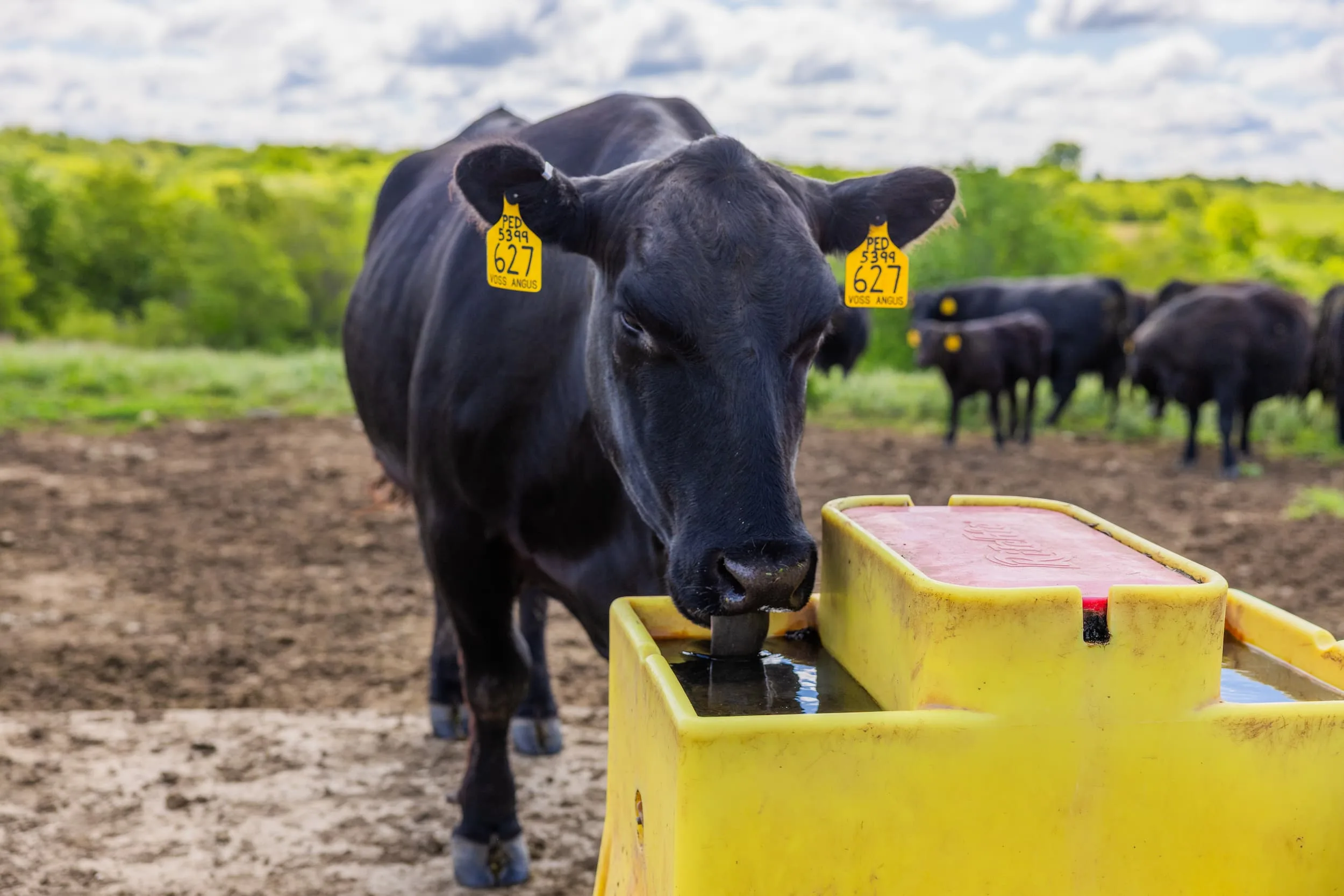
Do beef and dairy cattle have different water needs? The short answer: Yes. Hydration needs can vary dramatically between beef and dairy operations. But there’s a lot more to it than beef vs. dairy. Those needs vary even more when you’re talking about different seasons and stages of life. Calves, lactating cows and finishing cattle in summer heat all have different hydration needs. Understanding those changing demands can help support performance, health and water needs year-round.
Here you’ll find answers to some of the most common questions producers ask about cattle hydration.
Download the quick reference guide
Frequently asked questions that apply to both beef and dairy cattle
How do water needs change throughout an animal’s life?
Water needs change with every stage of life and then vary by breed and the environment. Here’s a general guide to the ranges of water needs per animal type.
| WATER INTAKE BY ANIMAL TYPE | |
| Animal | Average daily water intake |
| Cow-calf pair | 12-20 gal (45.42-75.71 L) |
| Dry beef cow | 6-15 gal (22.71-56.78 L) |
| Feedlot cattle | 8-25 gal (30.28-94.64 L) |
| Lactating dairy cow | 30-50 gal (113.56-189.27 L) |
| Calves | 2-5 gal (7.57-18.93 L) |
| Bulls | 10-20 gal (37.85-75.71 L) |
How does temperature affect cattle water intake?
Beef and dairy cattle have different water needs, but they both need more water as temperatures climb. During the summer months, animals work harder to regulate body temperature and maintain feed intake and performance — and the threat of heat stress is high. Factors like humidity, sun exposure, stage of production and diet all influence consumption, but it’s common for cattle to drink substantially more water during periods of hot weather. The chart below shows how water needs can change as temperatures climb.
| CATTLE WATER CONSUMPTION BY TEMPERATURE | ||
| Temperature | Beef Cattle Water Intake | Dairy Cow Water Intake |
| 20ºF (-6ºC) | 6-8 gal/day (22.71-30.28 L/day) | 15-20 gal/day (56.78-75.71 L/day) |
| 40ºF (4ºC) | 8-10 gal/day (30.28-37.85 L/day) | 20-25 gal/day (75.71-94.64 L)/day) |
| 60ºF (16ºC) | 10-12 gal/day (37.85-45.42 L/day) | 25-30 gal/day (94.64-113.56 L/day) |
| 80ºF (27ºC) | 12-16 gal/day (45.42-60.57 L/day) | 30-40 gal/day (113.56 L-151.41 L/day) |
| 90ºF+ (32ºC) | 16-20+ gal/day (60.57-75.71+ L/day) | 40-50 gal/day (151.41-189.27 L/day) |
Here’s how water consumption for beef cattle herds can change with temperature.
| EFFECTS OF TEMPERATURE ON ESTIMATED HERD WATER DEMAND | |||
| Herd size | Cool Weather Intake
(40-60ºF) |
Warm Weather Intake (80-90ºF) | Extreme Heat Intake (90ºF+) |
| 25 head | 250-300 gal/day
(946.35-1,135.62 L/day)
|
350-400 gal/day
(1324.89-1,514.16 L/day) |
450-500 gal/day
(1,703.44-1,892.71L/day)
|
| 50 head | 500-600 gal/day
(1,892.71-2,271.25 L/day) |
700-800 gal/day
(2,649.79-3,028.33 L/day) |
900-1,000 gal/day
(3,406.87-3,785.41 L/day) |
| 100 head | 1,000-1,200 gal/day
(3,785.41-4,542.49 L/day)
|
1,400-1,600 gal/day
(5,299.58-6,056.66 L/day) |
1,800-2,000 gal/day
(6,813.74-7,570.82 L/day) |
| 200 head | 2,000-2,400 gal/day
(7,570.82-9,084.99 L/day) |
2,800-3,200 gal/day
10,599.15-12,113.32 L/day) |
3,600-4,000 gal/day
(13,627.48-15,141.65 L/day) |
Air temperature isn’t the only factor that affects water consumption. According to the University of Tennessee Institute of Agriculture, if the water temperature is greater than 80ºF, cattle are less likely to drink it. If possible, place waterers under shade structures to keep the water cool.
What is the impact of clean water access on cattle performance?
The quality of the water cattle drink has a significant influence on their performance because it drives nearly every function within the animal. Feed digestibility, milk production, weight gain and reproduction all depend on water. And it sets the animal’s metabolism rate.
According to Purina Mills, water also has a major impact on forage digestion in the rumen. Cattle are unique because the rumen provides nearly 40 gallons of water storage. And if they don’t get enough quality water, the rumen won’t be able to turn forage into energy and add pounds of production.
Have you tested the quality of water your herd is drinking? Many producers haven’t. Here are some water quality guidelines. Check with your vet, nutritionist or local department of natural resources about testing your water.
| WATER QUALITY GUIDELINES FOR CATTLE | |
| Contaminant | Safe Levels |
| Total dissolved solids | < 3,000 ppm |
| Sulfates | < 500 ppm |
| Nitrates | < 100 ppm |
| pH | 6.0-8.5 |
Frequently asked questions about beef cattle hydration
How does hydration impact cattle weight gain?
Water consumption drives feed intake, so any factors that cause cattle to drink less will lead to reduced feed intake and consequently reduced performance, according to South Dakota State University Extension. Cattle generally drink 0.24-0.36 gallons (0.91-1.36 L) of water for every pound of dry feed they eat.
| WATER INTAKE VS. FEED INTAKE | |
| Water intake | Feed intake |
| 6-10 gal (22.71-37.85 L) | 20 lb dry matter |
| 8-15 gal (30.28-56.78 L) | 30 lb dry matter |
Do cattle drink differently on pasture than in a feedlot?
Cattle often drink differently on pasture compared to in a feedlot because their diets, movement patterns and access to water all change with the production environment. Pasture cattle may travel longer distances between grazing areas and water sources, which can affect both how often and how much they drink at one time. Grazing cattle also consume fresh forage that naturally contains moisture, especially during spring growth, which can reduce the amount of free-choice water they consume compared to cattle eating dry hay or concentrated feedlot rations.
In feedlots, cattle are typically consuming drier, higher-energy rations, which increases water demand. Research and extension data consistently show that water intake rises as dry matter intake increases, especially during hot weather. Feedlot cattle also tend to drink in groups and may crowd around waterers during heat events, making water space, refill rates and accessibility especially important, according to the University of Nebraska – Lincoln.
How far should cattle walk to water?
A rule of thumb when determining the location of water sources is to put them where cattle need to walk less than 1 to 1.5 miles to their water, according to Farm Progress. And if it’s rough pasture, they shouldn’t walk more than one-half to three-quarters of a mile, preferably less.
Do calves and young beef cattle need special water access?
According to South Dakota State University Extension, calves may not drink (and consequently eat very little) if they have never seen a waterer or water tank before. If they aren’t drinking, let waterers run over for a day or so to mimic the sights and sounds of natural water sources and help encourage calves to drink.
Frequently asked questions about dairy cattle hydration
How much water do lactating cows need?
Lactating dairy cows require approximately 0.54–0.60 gallons of water* per pound of milk produced. So, for example, a cow producing 100 pounds of milk daily could consume as much as 50 gallons (189.27 L) of water, according to the University of Nebraska Extension.
Why do dairy cattle require so much water?
Dairy cows need so much water because water plays a direct role in both milk production and feed intake. Milk itself is made up of nearly 87% water, so high-producing dairy cows require large amounts of water every day to support consistent milk production. As milk output increases, water demand rises alongside it.
Water intake is also closely tied to dry matter intake. Dairy cows that consume more feed require more water to properly digest and utilize nutrients, maintain rumen function and support overall health and production. If water consumption is limited — whether due to heat stress, poor water quality or inadequate access — feed intake often declines first, followed by reduced milk production and performance.
What happens if dairy cows don’t consume enough water?
If dairy cows don’t drink enough water, you’ll see lower feed intake, which will impact their health and performance with reduced milk production. Lower consumption of water will also increase cows’ risk of heat stress.
Does fresh water increase milk production in dairy cows?
According to the University of Nebraska – Lincoln, providing insufficient water or water of poor quality to dairy cattle can limit milk production and growth, and cause health problems. An adequate supply of clean water promotes normal rumen function, high feed intake, digestion and nutrient absorption. For guidance on water quality, see our Water Quality Guidelines for Cattle chart.
Where should waterers be placed in dairy facilities?
You’ll want to consider the traffic flow in your facility and areas that will reduce competition for water. Placing waterers near the parlor and feed bunks is always a good idea.
What should producers look for in a watering system?
When you’re looking for the best automatic waterers for your operation, reliability and cleanability in any season are important. And you’ll want to match water capacity and flow rate to your herd’s needs. This chart is a great guide.
| WATER CAPACITY AND FLOW RATE BY HERD SIZE | ||
| Herd Size | Minimum Water Capacity | Recommended Water-Flow Rate |
| 25 head | 200-300 gal/day (757.08-1,135.62 L/day) | 3-5 gal/min (11.36-18.93 L/min) |
| 50 head | 400-600 gal/day (1,514.16-2,271.25 L/day) | 5-8 gal/min (18.93-30.28 L/min) |
| 100 head | 800-1,200 gal/day (3,028.33-4,542.49 L/day) | 8-12 gal/min (30.28-45.42 L/min) |
| 200 head | 1,600-2,400 gal/day (6,056.66-9,084.99 L/day) | 12-20 gal/min (45.42-75.71 L/min) |
The water needs of beef and dairy cattle may look different, but the goal stays the same: ensuring cattle always have reliable access to clean, fresh water that supports health and performance in every season and stage of life. Your Ritchie dealer can help find the right waterers for your needs.
Download the quick reference guide
Footnotes:
*Number converted from from 4.5-5 lbs of water, University of Nebraska Extension.