

Stagnant water, algae blooms in the summer, and stock tanks full of ice in the winter were all problems Thomas Ritchie, an Oskaloosa, Iowa native, was busy trying to solve. In 1921, Ritchie patented the first automatic waterer valve that solved many of the headaches that farmers faced in getting water to their livestock. His automatic float-controlled watering equipment was connected to underground running water and heated with a kerosene lamp to keep the water flowing during the bitter cold. Farmers liked the labor-saving qualities of Ritchie’s patented waterer, and a new business was born.
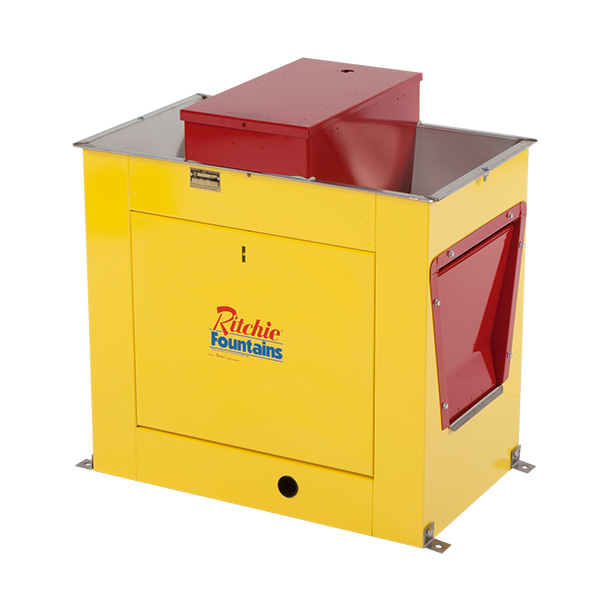 Livestock producers from Iowa and several other states were soon installing Ritchie’s waterers. In a written testimonial dated January 24, 1925, Walter L. French from Stratton, Nebraska noted: “We bought a hog waterer from you at the Nebraska State Fair last fall. It sure was a dandy. It has been 26 degrees below zero and have had warm water for our hogs at all times.”
In 1929 Ritchie incorporated and moved to an old machine shed in Marshalltown, Iowa. Part of the manufacturing also took place in a small machine shed in Conrad, Iowa until 1943. That year, blacksmith C.D. Wilson purchased Ritchie, moved the business to Conrad, Iowa, and operated the business out of a small blacksmith shop. Shortly after the move, automatic electric heat was introduced to the watering equipment helping to establish Ritchie as the leader in the industry.
After his father’s death in 1979, C. D. Wilson Jr. took the reins of the business and expanded its market and the technology of the product. To meet demands, the company had gone from making six models to more than 40, giving it the distinction of being the largest manufacturer and distributor of the most complete line of animal and livestock watering equipment in North America. In January 2004, Ritchie Industries became employee-owned.
“Today Ritchie Industries engineers, designs, and manufacturers waterers to serve every type of livestock – from an individual horse to 500 beef cattle,” said Robert Amundson, President and CEO of Ritchie Industries. “All of our waterers are engineered to meet the demands of beef producers everywhere. Troughs can be emptied, cleaned, and refilled in a fraction of the time it takes other waterers just to empty. Just like other technological advancements such as nutrigenomics and RFID tags have helped improve the efficiency of beef operations, we are constantly striving to improve your bottom line. If you haven’t thought about upgrading your watering systems, now is the time to look at what new innovations are on the market. Our WaterMaster series requires 75% less energy in the winter than concrete units and they won’t pit or cause cleaning problems. Our newest generation of the CattleMaster series blends the best of both worlds – the technology from traditional stainless-steel units and the newest poly units combined to make a premier waterer. The unit has thermostatically controlled heat for ice-free operation with a fast refill valve to give your cattle clean, fresh water in the toughest climates year-round.”
Iowa beef producers have been in a heavyweight fight with Mother Nature for the past couple of years. 2019 was the blow of devastating floods and 2020 is the one-two punch of drought and derecho damage. No matter how vicious the combination, beef producers always seem to find a way to get back up off the canvas and continue on.
The next battle producers are gearing up for is the winter season. One of the biggest concerns many producers are going to deal with is drought-stressed feedstuffs and long-term water supplies. According to the U.S. Drought Monitor, at the end of August 96% of Iowa was experiencing at least abnormally dry conditions with 29% of the state in severe drought and 7% in extreme drought. The numbers on October 1 look better but still indicate that almost 70% of the state is experiencing abnormally dry conditions with almost 23% experiencing severe drought.
THE PITFALLS OF POOR-QUALITY FORAGE
Early rains in the spring may have delayed the first cutting of the hay crop and the second and third cuttings have produced lower-quality hay. Counties that have experienced drought conditions have harvested hay crops that are stressed and more mature, affecting the total digestible nutrients (TDN). 24 counties in western Iowa were authorized this August to use Conservation Reserve Program (CRP) acreage for emergency haying and grazing.
“When it comes to forage quality there is a simple relationship of variables,” said Daniel Loy, Ph.D., professor of animal science at Iowa State University and director of the Iowa Beef Center. “The increased maturity of the forage leads to decreased quality of the forage. Looking specifically at previous samples of CRP forage, we see crude protein values as low as 2% to as high as 8% and energy values are frequently below 50% TDN. We strongly encourage producers to
invest in testing their hay or forage for nutrient analysis. This will help producers know how much protein and energy supplementation they will need for the cattle in differing stages of production.”
The crop damage from the August 10 derecho has prompted more farmers to consider harvesting their lodged corn for silage. This could potentially produce sileage with high nitrate levels which are toxic to cattle. If producers are considering feeding drought-stressed or derecho-damaged silage, it is advised that the silage is tested for nitrate levels prior to feeding.
Another pitfall for cattle this year will be grazing cornstalk fields. The drought has left many cornstalks weak and even minor winds caused some lodging which means there will be more corn and corn ears on the ground in the fields after harvest. Producers should plan to limit grazing or feed hay prior to turning them out in the fields to prevent overconsumption. Once the cattle eat the preferred nubbins, leaves and shucks that are low in nitrates, plan to move the cattle into new areas to avoid eating the high nitrate stalks.
DON’T FORGET ABOUT THE MOST IMPORTANT NUTRITIONAL INPUT – WATER
“Cattle absolutely need access to fresh water at all times,” said Loy. “Cattle are between 60-70% water, so making sure you have a high-quality water source is key to the overall health and productivity of the animal. In general terms, cattle need to drink about a gallon of water for every one pound of dry matter consumed.”
The effects of the lingering drought have had a major influence on water quality issues for producers throughout the state. Many surface water sources such as ponds and streams became stagnant and developed blue-green algae which produce toxins that affect the nervous system and liver.
“Whenever we go through an extended drought, many farmers start to think about their long-term water resources,” said Loy. “Hauling water is labor intensive and very costly. Farmers then start exploring developing a permanent water source that utilizes automatic watering systems which can be very cost-effective over the long term.”
Another water issue to consider during the winter months is monitoring your cattle’s lower critical temperature (LCT). Once the temperature dips below this point, your cattle have to expend extra energy to maintain a constant core body temperature. There are several factors that can affect your cattle’s LCT including hair coat thickness, body condition, weather conditions, hide thickness, etc. For example, a steer with a dry, heavy winter coat will have an LCT of 20°F, while a steer with a wet, light summer coat might have an LCT of 50°F.
“Cattle below the LCT will need to increase their metabolism which in turn requires more calories,” said Loy. “A general formula is that for every 1° below the critical temperature, the animal’s energy requirements increase 1%. Access to a plentiful, quality water supply then becomes critical because reduced water consumption leads to reduced feed intake which will stress the animal further. Another consideration is the actual temperature of the water. A healthy calf will have a temperature between 100°F and 102.5°F. If that calf drinks very cold water, he will have to expend energy to get that water up to his body temperature, even with heat generated by fermentation in the rumen. Providing water that is heated in the winter is more palatable and helps reduce cold stress.”
Since 1921 beef producers have relied on Ritchie Industries, Inc., an Iowa company that invented automatic waterers, to provide temperature-controlled, clean, fresh water on demand in all weather conditions.
“Ritchie Industries has been a pioneer and innovator in automatic livestock waterers for almost 100 years and our mission is to provide fresh water for life,” said Robert Amundson, President and CEO of Ritchie Industries, Inc. “Installing a reliable, clean water source is one of the key steps to becoming a sustainable and profitable operation. Ritchie waterers are also very energy efficient and meet the agricul- tural rebate requirements through participating electric cooperatives. Iowa producers who install electric heat- ed livestock waterers are eligible for up to $50 in rebates per waterer. In 2020, every little bit helps out.”
The Farmers’ Almanac is predicting “the winter of the great divide” for the 2020-21 season – cold and snowy in the north with drought in the west. Time will tell if this prediction is accurate but one thing you can count on is that cold winter weather can make even the simplest chore much more difficult. Plan now for a water winterization routine that can help eliminate any icy, frozen surprises.
Water is the Most Important Nutrient We Provide Our Animals
“Although water is the cheapest nutrient we may purchase or provide, it is the one we provide the most of on a per pound basis,” said Ted Wiseman, extension educator for Ohio State University Extension Beef Team. “Cattle will need to drink about seven pounds of water for every pound of dry matter consumed. Colder temperatures increase feed intake to generate body heat. Decreased water availability reduces feed intake which results in decreased body condition, poor fetal growth rates, and lactation levels.”
Whether your homestead has cattle, goats, sheep, pigs, camelids, horses, or all of the above, it is crucial that your stock have access to fresh, clean water at all times. All species of livestock prefer warmer water in the wintertime. For example, sheep prefer water between 45 degrees and 55 degrees, according to Tom Drudik, extension educator for University of Nebraska-Lincoln. Very cold water discourages adequate water consumption.
On a small scale, it can be difficult, time-consuming, and expensive to keep the water in your tank from freezing. Ritchie Industries, Inc., the Iowa company that invented automatic waterers in 1921, has designed an affordable product line for homesteaders called the Genesis Series that combines the benefits of automatic watering with the versatility of portable or permanent mounting options.
“If you’ve been lugging around buckets daily or dumping and scrubbing out stock tanks, the Genesis series has been designed with you in mind,” said Robert Amundson, President, and CEO at Ritchie Industries, Inc. “The Genesis series is all about convenience. The biggest advantage for smaller operations is the easy installation – no digging, you just hook up a 200 PSI garden hose to the waterer and you are in business. Our Classic Equine series is engineered specifically for horse owners and offers many options including water meters and stainless-steel construction. For our colder climate customers, Ritchie has a robust line of completely automatic waterers that can be combined with heating options.”
Prepare for Winter Before the Bitter Cold Sets In
No matter what system you use, there are some simple maintenance tasks you need to perform to keep your waterers and heaters operating at peak performance.
Step One: Clean Valve Chamber and Drinking Areas – Remove covers and use a brush or sponge to remove any debris that may have been collected in trough areas and valve chambers. Pay special attention to the area where the immersion heater is housed. Deposits can build up on the heater if it is continuously stored in the waterer.
Step Two: Check All Water Seals – Quality automatic waterers, like those manufactured by Ritchie Industries, Inc., can utilize water seals using tracks intended to hold water or vegetable oil during cold weather which will freeze or seal the covers down onto the unit during the winter. If the tracks are full of debris or other materials, they won’t seal properly, and cold air may leak in and freeze your valve system.
Step Three: Inspect the All-Weather Sealant
Check the all-weather sealant around the base of the unit and the concrete pad to ensure no gaps have formed that would allow air to penetrate the underside of the unit. Replace if needed. Before winter, make sure to inspect the unit to make sure no critters have taken up residence or caused damage.
Step Four: Install & Inspect Optional Heating Units – Inspect all units for any damage. Plug in and turn on the breaker to the immersion heater and/or heat cable after it is installed and underwater. Chill the water with ice to activate the built-in thermostat. You can also test by placing your immersion heater in a freezer for 10-15 minutes and then plugging it in without placing it in water. Either way, the heater should be warm to the touch within 15 seconds if it is working properly.
Units that have built-in thermostatically controlled heaters can be tested by simply turning the power on to the unit and filling the drinking areas with ice to activate the thermostats. If the ice melts away, your unit is operating properly.
Step Five: Troubleshoot Heating Elements – If your immersion heater is not becoming noticeably warm to the touch or if there is damage to the cord/wires, a new heater will be needed.
If the ice you poured in the thermostatically controlled drinking area of your unit does not melt away there are two main causes. If the ice melts on just one side of the unit, the heater on the opposite side may be malfunctioning and need replacing. If none of the ice melts, then your thermostat may need to be replaced or the power to the unit is faulty. If you suspect an electrical issue, consult with an electrician.
Self-regulating cable heaters are low wattage and do not feel noticeably warm to the touch. You may need to test this with a voltage meter or ask for assistance from an electrician. If this element goes out during the winter, you will notice that the drinking areas are free of ice, but you are not getting water from the valve.
Easy Water Solutions for Every Hobby Farmer and Homesteader This Winter
With a little maintenance and a solid winterization plan, you can keep the freshwater flowing this winter and keep your stock healthy and happy.
“There’s nothing worse than breaking ice or doing maintenance on a waterer when it is freezing outside,” said Amundson. “Ritchie offers a full line of durable, quality livestock founts that are cost-effective, innovative, and backed by the best warranty in the business. It is our mission to provide fresh water for life.”
Healthy horses spend 70 percent of their day eating forage and drinking water. During the winter, horses have a natural tendency to drink less water in colder temperatures so you need to be diligent with providing fresh, clean water at the right temperature.
Whether you use a high-end automatic waterer like Ritchie, Classic Equine by Ritchie or use an immersion heater in a tank, here are five easy steps to prep your waterer for the winter:
Step One: Clean Valve Chamber and Drinking Areas – Pay special attention to the area where the immersion heater is housed and remove all build-up/deposits.
Step Two: Check All Water Seals – If the tracks are full of debris or other materials, they won’t seal properly, and cold air may leak in and freeze your valve system.
Step Three: Inspect the All-Weather Sealant – Before winter, make sure to inspect inside the unit to make sure no critters have taken up residence or caused damage.
Step Four: Install and Inspect Optional Heating Units – Inspect all units for any damage. Chill the water with ice to activate the built-in thermostat. The heater should be warm to the touch within 15 seconds if it is working properly.
Step Five: Troubleshoot Heating Elements – If your immersion heater is not becoming noticeably warm to the touch or if there is damage to the cord/wires, a new heater will be needed.
Self-regulating cable heaters are low wattage and do not feel noticeably warm to the touch. You may need to test this with a voltage meter or ask for assistance from an electrician.
Company Also Honored as SBA’s Region 7 Exporter of the Year
(DES MOINES, Iowa) – The U.S. Small Business Administration has announced the selection of Ritchie Industries, Inc. in Conrad as the 2023 SBA Small Business Exporter of the Year for the state of Iowa. In addition, the company was also selected as the SBA Regional Exporter of the Year winner for SBA’s Region 7, which includes the state of Iowa, Kansas, Missouri, and Nebraska.
Ritchie Industries produces livestock watering tanks that are insulated, heated, and free-flowing to supply continuous fresh water to livestock. The company’s products are suitable for beef and dairy cattle, hogs, horses, sheep, goats, and exotic livestock. The products are built to withstand extreme weather conditions. Products range from a single stall waterer to fountains that accommodate 500 head of cattle. Some products are built to attach to a stall or fence line while others are free-standing. Products are generally heavily insulated and are constructed of stainless steel and/or roto-cast polyethylene for a long, freeze-free service life.
Thomas Ritchie, an Iowa farmer, invented an automatic animal watering system in 1921 for the purpose of keeping his own livestock supplied with fresh water. His invention became popular among the farmers in the area, so he patented the concept and sold it to farmers around the state. C. D. Wilson, Sr. purchased the business in 1943 and moved it to Conrad, Iowa. In 2004, Clifford D. Wilson, Jr. sold the Company to the Ritchie Employee Stock Ownership Plan (ESOP). Ritchie is currently led by President and CEO Robert Amundson who joined the company as a design engineer in 2006 and has since worked his way up through the company.
Exporting represents over 22 percent of Ritchie’s sales, with products being exported to Canada, Europe, Japan, and the Middle East. Most of the sales to Canada, Europe, and Asia are for larger units that are used in cattle and dairy operations. Exports are responsible for creating 17 jobs through exporting.
Ritchie utilized the SBA’s State Trade and Export Promotion (STEP) Grant Initiative to grow its export sales. Services under the STEP Program are funded in part by SBA nationally and delivered by state government organizations. In Iowa, the Iowa Economic Development Authority (IEDA) leverages federal funding with an existing IEDA program to support small businesses’ specific marketing efforts and expand their export markets. Last fall Ritchie used the program to participate in the Iowa pavilion at EuroTier 2022, in Hanover, Germany, the world’s leading trade fair for professional animal farming and livestock management.
In addition to the STEP Grant funding, Ritchie Industries also benefited from the SBA’s Paycheck Protection Program, which supported the company’s operations during the COVID-19 pandemic.
“The SBA Iowa District Office is thrilled to recognize Ritchie Industries’ success during National Small Business Week,” said Jayne Armstrong, district director of the SBA’s Iowa District Office. “It is a great example of the economic impact Iowa’s rural manufacturers have on international markets. We are especially proud to collaborate with IEDA to support the state’s successful export efforts.”
Ritchie Industries was nominated for this award by Peggy Kerr, Team Leader, International Trade Office, Iowa Economic Development Authority.