

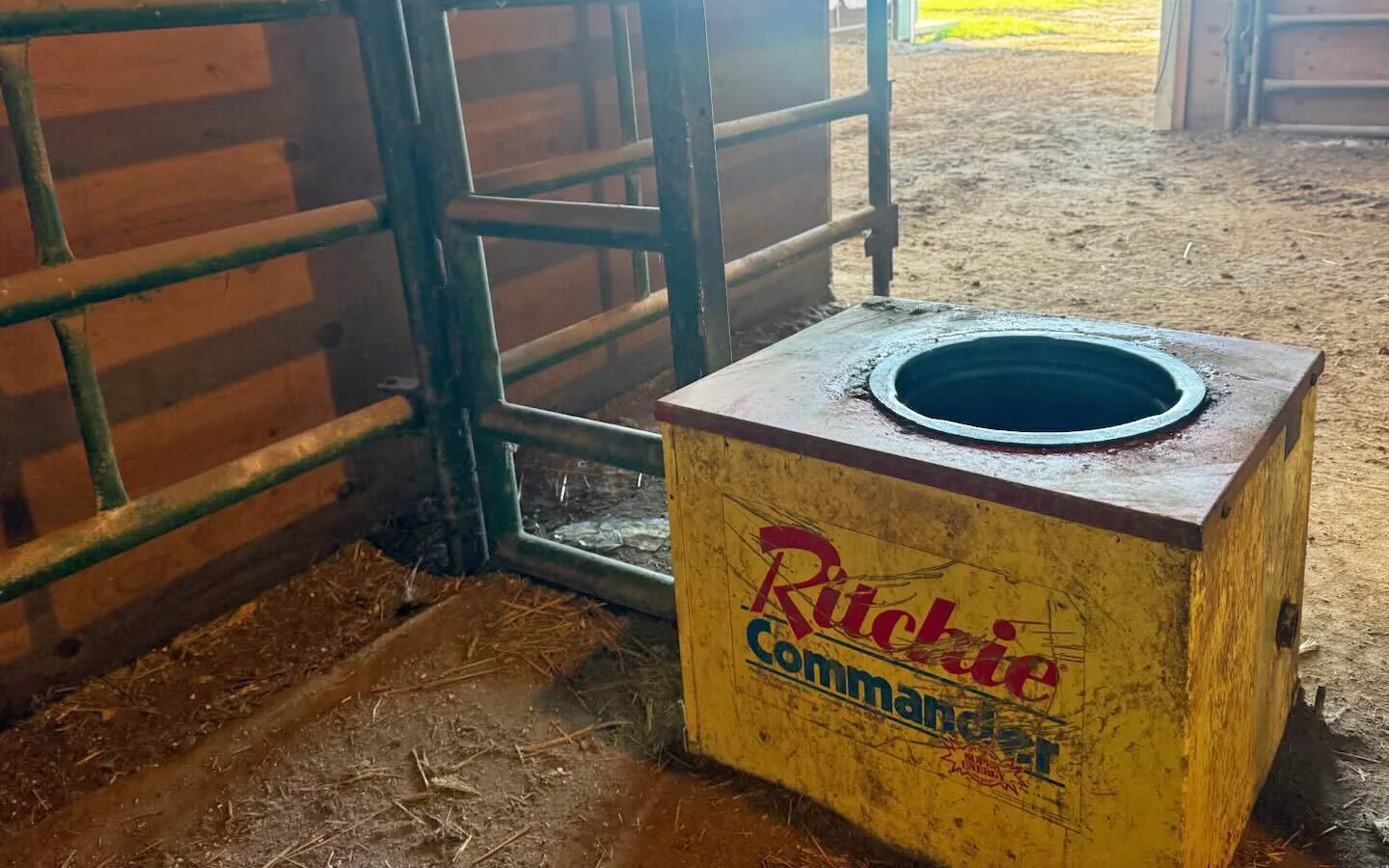
TIME FOR A NEW AUTOMATIC LIVESTOCK WATERER?
7 signs to watch and what to consider.
Your old waterer may still be running, but there may be some benefits to upgrading. Livestock watering has changed a lot in the last few decades, and an older unit could be quietly costing you in energy, labor and animal performance. Here’s how to tell when it’s time to upgrade and what to think about before you do.
7 signs it’s time to upgrade your automatic livestock waterer
1. Rust is coming through on an older metal unit.
If water gets through the epoxy powder coating on a metal trough, rust pockets form underneath, the epoxy starts chipping, and eventually you get rust holes in the trough. If you’re seeing rust through the trough, it’s time to start shopping.
2. The insulation is gone.
After years in the field, there’s often very little insulation left in older metal waterers. Today’s Ritchie waterers have at least 2 inches of polyurethane foam, so they insulate far better and keep cold air out. Take a look behind the access panel of an old waterer. “If there’s no insulation in there, you are running those heaters way more than you should,” Ritchie Chief Operating Officer Ed Sieverding said. “You’re just wasting energy at that point.”
3. Older poly units are fading or cracking.
Poly units show their age differently. Watch for color fading. As the pigment breaks down, the plastic’s UV stabilization can also break down. So, once the unit starts turning white or cracking, it’s probably time to replace it.
(Good news for anyone buying a new Ritchie: Modern Ritchies are made with a compounded resin with a UV stabilization package built to prevent those problems.)
4. Your GFCI keeps tripping.
The electrical connections on many older units hang loose under the trough. Moisture collects there, especially with high groundwater coming up through the thermal tube. That condensation can trip a GFCI (ground fault circuit interrupter). Modern Ritchie units are designed to avoid this. Talk to your electrician to learn more about proper electrical connections to keep your waterer running.
5. Someone’s breaking ice every winter day.
This is one of the easiest signs to spot. Degraded insulation, damaged heating components, or worn-out seals can cause an old waterer to freeze up. “If you’ve got a guy that’s out there every day busting ice, why?” Sieverding asked. “Don’t do it. Put something new in. Save his time for doing the things that add dollars to your bottom line.”
6. Your herd is waiting on water
If animals drink the trough down and then stand around waiting for it to refill, something isn’t keeping up. That could be the waterer, but it could also be the water supply line. Check with your plumber to ensure your supply line is big enough to feed a quick-fill valve.
Watch your numbers, too. Dairies that see output drop and feedlots that see gains slip should take a hard look at their waterers.
7. Replacement parts are running out
If your old waterer is a Ritchie, we still have repair parts for electrical systems. But access panels and covers for the old all-metal units are only available while supplies last. Once those are gone, a new system is the way to go.
Rule of thumb: The last all-steel Ritchie units were made in 2013. If you’re running an all-metal unit, you’re past the 10-year mark and should start planning your upgrade.
Should you repair or replace your automatic livestock waterer?
We’re always evolving our designs, and some upgrades make a big difference on their own. Take the OmniFount 2: Older models had troughs with welded corners. The new trough has smooth, rounded corners and beveled edges that direct water toward the drain area.
“It’s night and day better,” said Sieverding. “Dramatic improvement in cleaning capability and just user friendliness.”
If a newer design fixes the problems you’re dealing with every day, replacing the unit usually beats repairing it.
What to consider when you upgrade
Herd size and capacity
Ritchie rates every unit for the number of head it can handle. The math uses about 11 inches of drinking perimeter per head, planning for up to 5% of the herd drinking at once. We then check that against the valve’s flow rate and the “slurp rate,” which is how fast cattle drink.
If your operation has grown past your waterer’s capacity, you have options:
-
-
- Add a unit next to the one you have by teeing off the existing line.
- Add a unit somewhere else if you want the flexibility to split pastures.
- Move up a size by expanding the concrete pad and upgrading to a larger unit.
-
Your water line
Ritchie controls what the valve can do. You control what feeds it. Make sure your water line is sized to keep up with the valve’s flow rate, or even the best waterer won’t meet demand.
Your climate
-
-
- Cold climates: Many all-poly units keep open water inside the valve chamber and just outside it. When animals drink, it pulls warm water into the trough. If you want the full trough open and ready right away, look at a CattleMaster or OmniMaster waterer.
- Warmer climates: If you only get a few weeks of hard cold, energy-free units are a popular choice. They also skip the cost of running electric out to the waterer.
-
Costs beyond the price tag
When you budget to install a brand-new waterer, include:
-
-
- A concrete pad, since Ritchie automatic livestock waterers require a noncombustible surface.
- Trenching for your water line.
- Electrical for heated units that need copper run out to the site along with the poly water line.
-
Long-term savings
A new waterer can save you money over time.
-
-
- Energy: A standard stock tank needs a large immersion heater to stay ice-free. A Ritchie uses far less energy.
- Water conservation: When you clean a 1,500-gallon stock tank, you have to dump 1,500 gallons of water. Cleaning a 40-gallon Ritchie automatic waterer means dumping only 40 gallons.
- Animal performance: Research on drinking water quality has linked clean, fresh water to up to a 3% improvement in gains per head,1 especially in feedlots. Across 2,000 head, that adds up fast.
-
The bottom line
If your old waterer still works and you don’t mind the electric bill, you can stay the course. But if you’re dealing with ice, tripping breakers, rust, or a herd waiting to drink, a new unit can save you time, cut maintenance, and make cleanup easier.
Ready to find the right fit for your operation? Use our product match tool and contact your local Ritchie dealer to compare models and find the right waterer for your herd and climate.
1 Beef Cattle Research Council. (2018, April 5). How quickly do water systems pay for themselves? New calculator available. BeefResearch.ca. https://www.beefresearch.ca/blog/how-quickly-do-water-systems-pay-for-themselves-new-calculator-available/